Electricity submeter: essential for cutting your energy bill
A main meter gives you a figure. A network of electricity submeters lets you analyse a site's consumption in detail. It is by properly understanding your energy uses that you can put in place actions to make savings.
A manufacturer receiving an electricity bill sees a total consumption figure. The breakdown is rarely known. The main meter installed by the electricity supplier adds everything up but does not explain how energy is used. Faced with this limitation, more and more industrial companies are installing electricity submeters, able to measure consumption area by area, workshop by workshop, machine by machine. They gain a far better understanding of their energy consumption and can take decisions to reduce it.
The limits of the main meter
A building's main meter exists above all for billing purposes. It measures what enters the building's electrical network and allows the energy supplier to issue an invoice. It is a necessary instrument, but its usefulness stops there.
Feedback from the US federal programme on energy compliance in public buildings (EPAct 2005) clearly illustrates this limitation.
A study carried out for the US Department of Energy ranked the savings achieved according to how far metering data was actually used.
Simply installing a meter, with no analysis and no action, generates only 0 to 2 % savings, an effect largely attributed to the mere fact of being observed. Limiting the exercise to allocating the bill between departments or buildings, without digging further, caps gains at around 2.5 to 5 %. The main meter belongs precisely to this first level: it tells you how much you spend, not where or why.
Source: “Metering and the new federal requirements of energy policy act 2005”, U.S. Department of Energy, 2006
Electricity submeters reveal how energy is used
An electricity submeter, single-phase for light circuits or three-phase for high-power industrial equipment, is installed downstream of the main meter, as close as possible to the use being monitored. Air compressor, furnace, production line, lighting in an annexe building: every significant load can have its own measurement point.
ADEME recommends this approach in its recommendation no. 229 on industrial energy performance. Installing energy meters per use on the most energy-intensive equipment is one of the most effective levers for identifying malfunctions and reducing waste, a load-by-load rather than global measurement logic that provides the granularity required for any continuous improvement approach.
Source: ADEME, the French agency for ecological transition
Industrial feedback reported by the specialist management press points in the same direction. Rolling out a structured submetering plan generally identifies between 10 and 20 % of potential savings on the electricity bill, revealing equipment left running outside production hours, leaks or poorly adjusted operating times.
Source: “Compteurs électriques industriels : comment le sous-comptage transforme la gestion énergétique des entreprises ?”, La Lettre du cadre territorial, 2026
The study on US federal buildings confirms this progression. An in-depth diagnosis combined with simple maintenance and operating improvements, made possible by detailed measurement, generally delivers between 5 and 15 % savings, while continuous management combining better knowledge of uses, correction of drifts and permanent monitoring can reach 14 to 45 %.
Source: “Metering and the new federal requirements of energy policy act 2005”, U.S. Department of Energy, 2006
Electricity submetering is therefore not simply a more accurate version of the main meter. It is the tool that makes action possible, where global metering merely records.
A concrete case: identifying a device wasting $19,000 of electricity a year
The case of the chemical group Solutia, in the United States, gives an idea of the ratio between the cost of a submeter and the benefit obtained. At its Trenton site in Michigan, the energy team suspected that a back-up air compressor was running when it was not needed.
An electricity submeter was installed on this equipment. The data collected showed that an air dryer associated with the compressor was running continuously for no real reason. The dryer was then reconfigured to operate only as back-up, like the compressor it serves, rather than permanently.
Source: “Industrial technologies program”, U.S. Department of Energy, 2011
This kind of result is nothing exceptional in a plant equipped with submetering. Once the data is available continuously, it also helps to spot other anomalies, such as an air line damaged by frost, or to justify installing variable speed drives on pumps and compressors that are poorly sized for their actual use.
Measurement then becomes a day-to-day decision-making tool, not just a monitoring indicator.
Connected submetering and analysis software: the winning duo
An electricity submeter installed without regular use of the data loses much of its value. Industry professionals make the point: raw data alone has no value, it has to be analysed to support decisions. Connected submeters, able to transmit their measurements in real time, change the game.
Combined with energy management software, they make it possible to visualise load curves, automatically detect consumption drift and trigger an alert before a problem becomes expensive.
A study carried out by Qualisteo among companies that deployed a network of connected submeters combined with energy analysis software measured average savings of 12.4 % over 2025.
This figure, consistent with the ranges observed in international feedback, illustrates the effect of combining fine measurement with active management: submetering alone provides visibility, continuous analysis turns that visibility into measurable savings.
Source: internal study, Qualisteo, 2026
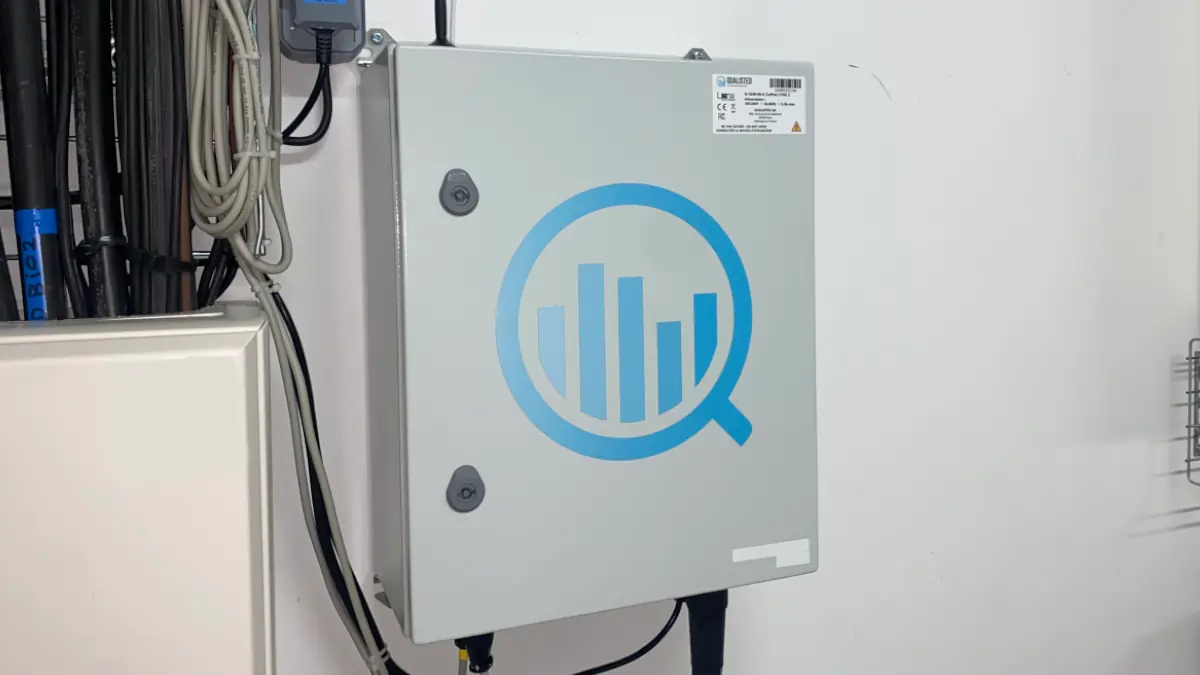
This is precisely the approach developed by Qualisteo. The non-intrusive connected electricity submeter measures consumption at use level.
The data is sent in real time to the Wattseeker energy management software platform, which makes it possible to analyse consumption, set alert thresholds and build a concrete action plan.
Energy efficiency engineers then support the technical teams in interpreting the data and implementing corrective actions, often the decisive step in turning a metering project into a measurable result on the bill.