
Tertiary Decree: towards reducing energy consumption

The information on this page concerns the regulations in force in France
For tertiary buildings, the July 2019 decree requires a progressive reduction in energy consumption by 2050.
What is the Tertiary Decree?
The tertiary decree, also known as the tertiary renovation decree, details the terms of application of Article 17 of the Energy Transition Law. This decree concerns the obligation to improve the energy performance of tertiary premises in order to achieve a 60% reduction in energy consumption by 2050. The tertiary decree requires owners and tenants of tertiary buildings over 1,000 m² to reduce their final energy consumption.
Calendar
The calendar sets targets for reducing building energy consumption
Step 1: 2030
40% reduction compared to reference consumption
Step 2: 2040
50% reduction compared to reference consumption
Step 3: 2050
60% reduction compared to reference consumption
Objectives of choice
In practice, those concerned have a choice between two objectives:
Relative objective (CRELAT)
This involves reducing the building's energy consumption by -40% by 2030, -50% by 2040 and -60% by 2050.
Absolute value objective (CABS)
The objective is to reach a consumption threshold expressed in absolute value. This threshold is set according to the type of activity carried out in the building, its geographical area and altitude. Results can be pooled at the portfolio level.
How to comply?
Here are the three steps to follow to properly apply the tertiary decree:
- 1Find out about the obligations related to the tertiary decree
- 2Set up an automated data transmission system on the "Operat" platform
- 3Monitor and document savings achieved compared to the previous year
Determining the reference year
The key step in achieving this objective is defining the reference year.
The reference year is the one on which the analysis of the evolution of the company's consumption will be based, and which will validate the achievement of the objective.
The reference year must be between 2010 and 2020, and ideally the chosen year should predate any improvements and energy consumption reductions already implemented in the company.
It must correspond to a full year of operation, i.e. 12 consecutive months.
The reference year must be declared on the ADEME's OPERAT platform, by 30 September 2022.

This reference year is defined by a Qualisteo CMVP-certified engineer based on climate variations, activity and any element impacting consumption.
Qualisteo's Energy Managers determine reference years through precise methodology and expertise (IPMVP certification).
Wattseeker, the compliance tool
The tertiary decree is not limited to determining the reference year. Site data must be clearly quantified and tracked by use, and savings must be monitored and demonstrable. The Wattseeker platform, a true Energy Management System software, makes it possible to separate consumption by different uses and monitor changes in real time by zone and use, and transfer all necessary data over time to be in full compliance with the tertiary decree and guarantee achievement of objectives.
See also
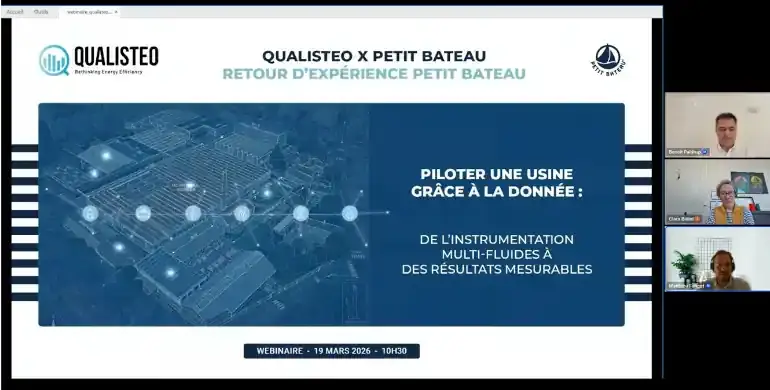
Petit Bateau's experience: managing an industrial site through data
Discover how the implementation of multi-fluid metering allowed Petit Bateau to achieve significant energy savings
Replay available
ISO 50001 Standard: how to turn this legal obligation into a lever for energy performance?
With rising costs, environmental requirements and ever-stricter regulations, implementing an Energy Management System (EMS) has become a necessity.
Replay available
ISO 50001 White Paper
The ultimate guide to help you implement the ISO 50001 standard (energy management) in your company
Download