How to obtain ISO 50001 certification step by step
From management commitment to the recertification audit, ISO 50001 certification follows six steps.
Under European Directive 2023/1791, companies consuming more than 85 TJ per year, around 23.6 GWh, will need a certified energy management system before 11 October 2027. For many industrial sites, ISO 50001 certification has become a project to plan now. The process has two phases. The company first builds its energy management system (EnMS) internally, then an accredited body verifies its compliance. Its duration depends on the chosen scope and the existing organisation.
Step 1. Formalise the energy policy and define the scope
Management decision
Management drafts an energy policy that formalises the company's commitments regarding consumption, energy efficiency and regulatory compliance.
Read also: ISO 50001 certification obligations around the world
Appoint the people in charge
The standard requires management to allocate the necessary resources and define responsibilities. A management representative is appointed and an energy team is set up. The certification scope is set at this stage. It specifies the sites, activities and energies covered.
Assess the extent of the transformation
A gap analysis then compares existing practices with the requirements of the standard. It lists the elements to put in place before the certification audit. Some certification bodies offer this diagnosis.
Step 2. Energy review, energy baseline and EnPIs
Energy review
The energy review analyses energy uses and consumption. It identifies significant energy uses (SEUs), assesses their current performance and estimates future consumption.
Measure consumption at the level of each use
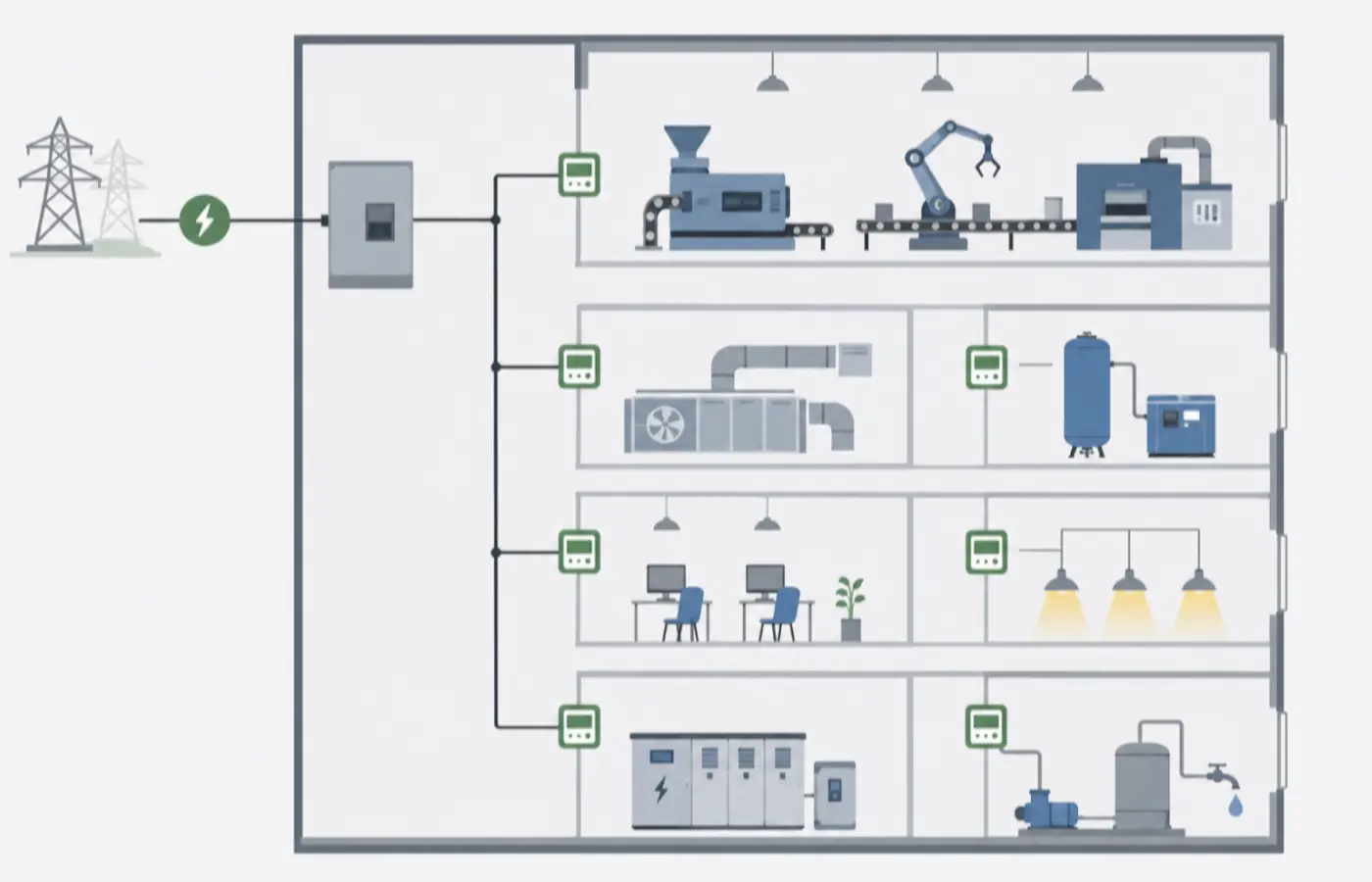
This analysis requires data broken down by use. A global bill does not show the share of each production line or each utility. Electrical and multi-fluid sub-metering provides this level of detail.
Read also: Why is energy sub-metering mandatory for ISO 50001 certification?
Define performance indicators
The review leads to the energy baseline (EnB). It serves as a point of comparison to demonstrate real improvement, independent of the weather or the level of activity. Energy performance indicators (EnPIs), for example kWh per tonne produced, measure the deviation from this baseline.
Finally, the company sets measurable objectives and the corresponding action plan.
Step 3. Deploy the action plan and the measurement plan
Improve operations and maintenance
The energy management system now leaves the paper stage. The action plan is deployed. For each SEU, the company defines operating and maintenance rules that preserve its energy performance.
Read also: 5 levers to reduce a factory's energy consumption
Raise staff awareness
The staff concerned are trained and made aware of the reduction objectives. The standard also covers purchasing. Energy performance becomes a selection criterion for equipment with a significant impact on consumption.
Set up sub-metering
Monitoring relies on a sub-metering plan. It defines the quantities measured, the measurement points and the frequency of readings. These readings feed the monitoring of EnPIs.
Read also: Why does installing sub-meters lower the energy bill?

Step 4. Test the system through the internal audit and management review
The internal audit verifies that the EnMS complies with the standard. It can be carried out by company staff, provided the auditor is trained and independent of the activities assessed.
The management review then examines the results. It decides on corrective actions and sets new objectives.
Step 5. Pass the ISO 50001 certification audit
It takes place in two stages. The document audit covers the energy policy, the energy review, objectives, EnPIs, action plans and monitoring procedures. If this phase is satisfactory, the auditor visits the site. They interview the teams, observe practices and check consumption readings.
If there is no major non-conformity, the body issues the certification. Otherwise, the company corrects the gaps before being certified.
Step 6. Maintain certification over the three-year cycle
The certification is valid for three years. The body carries out a surveillance audit every year. At the end of the cycle, a recertification audit determines whether the certificate is maintained.
The standard requires continual improvement in energy performance to be demonstrated, without setting a level to be reached. The EnPIs monitored since the energy baseline provide the evidence at each audit.
How Qualisteo supports ISO 50001 certification
Qualisteo offers an ISO 50001 support service ranging from the initial diagnosis to preparation for the certification audit. The certificate is then issued by an accredited body.
The process begins with an energy diagnosis. This mini-audit assesses the company's maturity in terms of documentation and in the field. It serves as a gap analysis and is used to size the rest of the support.
Training on the ISO 50001 standard is then provided to the teams concerned.
Next comes the deployment of measurement. The Lynx-E non-intrusive sub-meters for electricity and Lynx+ to measure fluids such as water, gas, compressed air or fuel oil record consumption by zone and by use. The Wattseeker platform centralises and analyses this data in real time. It feeds the energy review, the identification of SEUs, the energy baseline and the EnPIs.
On this basis, Qualisteo's energy efficiency engineers set up the energy management system with the company. They start from the existing organisation to formalise the energy policy, objectives, action plan, measurement plan and monitoring procedures.
Finally, an internal audit concludes the support. It assesses the EnMS, makes recommendations and prepares the company for the certification audit.